
Skill mastery is an allusive goal. To become highly proficient in any discipline it takes a lot of time, dedication and of course practice. While participating in a rescue class recently my instructor told a story of a conversation that took place between he and his martial arts mentor. In his own words he said "I asked my mentor, how many times must I practice this skill? to which he replied 'at least one more time', this was his answer and it never changed". The concept here is that continual practice is required in order to master a skill. Infact, we many never really "master" any thing at all. We use our skills in situations that are dynamic and unpredictable with both foreseeable and unforeseeable variables combining to form an infinite number of possible outcomes. This is why training is so critical and it is the reason that a group of high country rescue agencies convened this spring for a day of training.

When someone is injured in the backcountry their successful rescue often involves cooperation between different agencies and departments. Efficient communication is critical to achieving a rapid response. Successful rescues are made possible through the culmination of planning, practice and evaluation. This weekends training was organized by the National Park Service and involved participants from Watauga Rescue, Linville Central Rescue, Boone Fire and Watauga Medics.

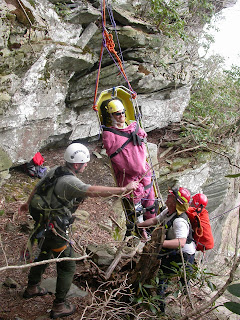
The scenario which took place at Ship Rock a popular climbing area, simulated a situation in which a climber fell from over 15 feet sustaining multiple injuries. The various participating agencies were "dispatched" to the scene where they were responsible for providing medical treatment as well as evacuation. The accident took place on a flat ledge several feet wide and required lowering the patient in a litter over a 20 foot vertical drop. Successful rescue required the participants to manage patient care while rigging a safe lowering system.

The initial assessment took place as medical rescuers arrived to find a male patient in his late 20's laying on the ground in pain. A rapid assessment was performed identifying injuries to the leg and pain in the arm, neck and back. The medical rescuers immediately immobilized the patients cervical spine and called in a request for additional resources. Command which was stationed 1/4 mile down on the blue ridge parkway, then sent additional personel and supplies. The medical team was able to evaluate the severity of the patient's injuries by trending the patient's vital signs over a period of time. Because the patient was stable. they were able to determine that a helicopter rescue, which can be costly and dangerous, would not be necessary. Meanwhile efforts to establish a safe lowering system were well under way on the ledge adjacent to the patient.


Evacuating the patient from the ledge required the use of a relatively complicated lowering system. With few good trees to anchor to, rescuers were required to place gear in cracks in the rocks in order to set up sturdy anchors. Each anchor had several points of contact with the rock and all were backed up by additional safety points. Redundancy is a key component of developing a safe mechanical system. The lowering system was designed so that if any component of the system were to fail at any point, it's function would be maintained by a parallel component. Once tested and determined to be safe, the patient was loaded into the stokes basket and lowered over the cliff.


The final stage of the excercise was to "debrief" the incident by discussing the various aspects of both the medical and rescue interventions. As a representative of Watauga Medics I had the opportunity to perform the medical evaluation while Robbie Calloway of Linville Rescue served as the rigging evaluator. Overall the training was a success. Treatment was provided rapidly and appropriately and evacuation was safe and effective. Most importantly, we all went home at the end of the day uninjured and hopefully more aware.

As we finished the debrief up on the ledge with Gradfater Mountain in the background, clouds covered the sun and a cool air arrived to greet the spring evening. Although we started the day in short sleeves and I woke up the next morning a little sunburned, the change in weather reminded me just how quickly things can change and just how important it is to be prepared for when things do change. This is a lesson I'm sure I will learn at least one more time.


