Tuesday, September 16, 2008

Summer Guiding

Summer is long over and fall is rapidly setting in. We've been busy gearing up for fall classes, but not too busy to reflect on a great summer out west. With near perfect conditions in the Colorado Rockies and a strong desire to take a break from emergency medicine, I headed west for two months of guiding. As the flat land receded and the snow capped mountain peaks began to poke above the dirt of the plains, it was difficult not to mash the accelerator all of the way down to the floor. Though I've made the trip half a dozen times now, I still get that giddy child-like excitement every time I see the rockies through the windshield. I have to give credit to my employer for the uncommon generosity of allowing me to take two whole months off at a time without sending me off to the river with a pink slip in my pocket. Thanks to Craig Sullivan at Watauga Medics Inc. for letting me go, and better yet, letting me come back!


Once in Colorado it's a short drive up to Clear Creek Rafting where I have spent five out of the last eight seasons guiding rafts and running safety support for class III and IV whitewater trips. Clear Creek is a roadside run that parallels I-70 for much of the way. Never the less it still boasts some wonderful scenery, hidden canyons, and some of the best commercial whitewater anywhere. It is not uncommon to find guides that have worked 10-20 seasons exclusively on Clear Creek.

Thankfully, we were blessed with a relatively safe summer even with higher than normal water levels. I did come home however, with a few rescue stories all of which were resolved with pleasant conclusions. Here is a brief account of one of those situations and a few of the lessons learned.

High water on the Arkansas early this summer brought frequent gorge closings as well as big water excitement. I had the opportunity to get some big water safety kayaking in on the Royal Gorge with some of the greatest guides anywhere which brings me to Lesson #1:
The river does not discriminate! Whether you are running a river for your first time or a seasoned veteran, the liquid world is dynamic and sometimes unforgiving. Accidents happen even to the most well trained river runners.


Such was the case on the Arkansas, where high water and unknown forces combined to result in several early season fatalities. This, I know was on all of our minds as we entered the Royal Gorge for a high water run the first day it re-opened after being closed by the park service. What can I say about nerves? Fear, or at least concern should be present on every river trip. Fear keeps us alert and it keeps us open to possibilities. It can, however, be crippling. It can cloud our minds, skew our judgement and ultimately lead to mistakes.

I can honestly say that I took some of that fear with me into the gorge that day. I think the other guides would admit the same. Safety kayaking is a unique responsibility. Should you have difficulty there is little a commercial raft can do to help you in continuous whitewater. It is very much like running solo, and yet you have the added responsibility of being "on call" for whatever chaos may ensue.


This day our trip was to be blessed with clean lines and big smiles. We blasted through the first sets of major rapids without incident tumbling towards "the narrows" a quarter mile long stretch of whitewater where several thousand cfs of water pushes through 1000 ft. vertical towers of rock that constrict the river down to about 25ft in width. It is a powerful place which commands respect and awe.


As we entered the last hundred yards of the narrows I noticed that something was horribly wrong. Off to the right was a partially submerged raft belonging to another company. Behind it clung half a dozen terrified looking people some of which were pinned between the raft and the rock. For a split second I considered attempting to eddy out just the right just above the chaos, then I remembered my priorities. I had rafts of my own behind me to which I was responsible. As a guide you are responsible to yourself first, your guests second, and any one else third. It was difficult for me to pass by the stranded paddlers knowing they were in imminent danger. Never the less, our trip came through smoothly and was able to pull aside just below the site of the accident in order to offer any assistance that may be needed.


The first few minutes were total chaos. We could not see the stranded boat from our vantage point and had no idea how many paddlers were missing. Lesson 2: Communication is key! With any critical incident the way priorities are assessed and managed very much depends on the ability of the people involved to communicate needs and develop a plan. This is particularly challenging on the river where you cannot just hit the pause button. It is difficult to hear making hand signals and improvised communication a must. All the while the river keeps on screaming by, it does not wait for you to get ready.

All would turn out well this day. The stranded paddlers were able to swim to safety or were rescued by throw rope. The guides unpinned the raft and one guest sustained a minor leg injury. Guides from several different worked together to resolve the situation. Lesson 3: we are all one on the river. It doesn't matter what flag you wave or who you voted for last election. when the proverbial poop hits the fan you better be ready to put it all aside and get the job done. The river can divide land leave people stranded on opposite shores, but more so I've seen it bring people together just as it did that day on the gorge.  Well that's all for now. I'll save my last two stories for the campfire. We're off to Gauley Fest for the weekend then back home to put the finishing touches on this fall's swiftwater rescue class.  Be safe...

Tuesday, May 6, 2008

High Angle Rescue Training


Skill mastery is an allusive goal. To become highly proficient in any discipline it takes a lot of time, dedication and of course practice. While participating in a rescue class recently my instructor told a story of a conversation that took place between he and his martial arts mentor. In his own words he said "I asked my mentor, how many times must I practice this skill? to which he replied 'at least one more time', this was his answer and it never changed". The concept here is that continual practice is required in order to master a skill. Infact, we many never really "master" any thing at all. We use our skills in situations that are dynamic and unpredictable with both foreseeable and unforeseeable variables combining to form an infinite number of possible outcomes. This is why training is so critical and it is the reason that a group of high country rescue agencies convened this spring for a day of training.


When someone is injured in the backcountry their successful rescue often involves cooperation between different agencies and departments. Efficient communication is critical to achieving a rapid response. Successful rescues are made possible through the culmination of planning, practice and evaluation. This weekends training was organized by the National Park Service and involved participants from Watauga Rescue, Linville Central Rescue, Boone Fire and Watauga Medics.


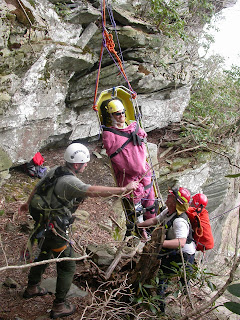
The scenario which took place at Ship Rock a popular climbing area, simulated a situation in which a climber fell from over 15 feet sustaining multiple injuries. The various participating agencies were "dispatched" to the scene where they were responsible for providing medical treatment as well as evacuation. The accident took place on a flat ledge several feet wide and required lowering the patient in a litter over a 20 foot vertical drop. Successful rescue required the participants to manage patient care while rigging a safe lowering system.


The initial assessment took place as medical rescuers arrived to find a male patient in his late 20's laying on the ground in pain. A rapid assessment was performed identifying injuries to the leg and pain in the arm, neck and back. The medical rescuers immediately immobilized the patients cervical spine and called in a request for additional resources. Command which was stationed 1/4 mile down on the blue ridge parkway, then sent additional personel and supplies. The medical team was able to evaluate the severity of the patient's injuries by trending the patient's vital signs over a period of time. Because the patient was stable. they were able to determine that a helicopter rescue, which can be costly and dangerous, would not be necessary. Meanwhile efforts to establish a safe lowering system were well under way on the ledge adjacent to the patient.


Evacuating the patient from the ledge required the use of a relatively complicated lowering system. With few good trees to anchor to, rescuers were required to place gear in cracks in the rocks in order to set up sturdy anchors. Each anchor had several points of contact with the rock and all were backed up by additional safety points. Redundancy is a key component of developing a safe mechanical system. The lowering system was designed so that if any component of the system were to fail at any point, it's function would be maintained by a parallel component. Once tested and determined to be safe, the patient was loaded into the stokes basket and lowered over the cliff.


The final stage of the excercise was to "debrief" the incident by discussing the various aspects of both the medical and rescue interventions. As a representative of Watauga Medics I had the opportunity to perform the medical evaluation while Robbie Calloway of Linville Rescue served as the rigging evaluator. Overall the training was a success. Treatment was provided rapidly and appropriately and evacuation was safe and effective. Most importantly, we all went home at the end of the day uninjured and hopefully more aware.


As we finished the debrief up on the ledge with Gradfater Mountain in the background, clouds covered the sun and a cool air arrived to greet the spring evening. Although we started the day in short sleeves and I woke up the next morning a little sunburned, the change in weather reminded me just how quickly things can change and just how important it is to be prepared for when things do change. This is a lesson I'm sure I will learn at least one more time.


Sunday, April 13, 2008

First Annual Student Wilderness Medical Conference


The first annual student wilderness medical conference has just wrapped up, and what an event it proved to be. While folks in Boone were captivated by a host of adrenaline fueled outdoor movies offered up at the Banf Film Festival, participants in
Winston were diligently comparing notes on adrenaline fueled accidents
.
Student organizers Stephanie Lareau and DJ Williams organized the event with the help of the Appalachian Center for Wilderness Medicine and a group of other dedicated sponsors. The conference which was held at Wake Forests School of Medicine was designed to allow participants to network, learn, and exchange ideas about wilderness, pre-hospital emergency care. Student organizer Stepanie Lareau admitted that at first she was sceptical about what sort of draw the conference would have. The fact that she made this confession in the auditorium filled with over 125 participants is testament to the hard work put in by organizers over the last year.


The conference drew students from 14 states throughout the country with participants coming in from as far away as Texas and Florida. Topics covered in the conference included international travel, military medicine, medicine in developing countries, bites and stings, endurance induced illness, traumatic injuries, and more. Most of the topics were held as afternoon electives following a morning of lectures broken up by an excellent lunch in the courtyard.


For those of you interested, you don't have to be a med student to join in on the action, but you do have to wait until the next event. Next years conference is already slated to be held at UNC Chapel Hill and more information can be obtained by contacting the Appalachian Center for Wilderness Medicine at http://www.appwildmed.org/. Also, check out the Wilderness Medical Society for updates on other upcoming events.


Monday, January 7, 2008

Why Sundog?


A sundog is a common yet spectacular atmospheric phenomenon which occurs as light from the sun is reflected by hexagonal shaped ice crystals in the sky. This beautiful natural event was first brought to my attention in the high desert of Utah by American Indian healer Bob Dodd. For me the sundog is significant in that it represents the transition that takes place as knowledge and understanding emerge from uncertainty. The sundog represents that "aha" moment where everything clicks into place, where confidence surpasses doubt.  Since the first day I was introduced to this magical event, sundog recurrences have been timely and meaningful.  This sundog photo was taken in North Carolina from the Flatop Mountain fire tower in early November 2007 on the day of my 30th birthday.