Monday, December 12, 2011

Let's Join Forces To Help a Community In Need!


Dear Friends,

I need your help!  During these tough times here at home it is easy to forget that there are many communities experiencing even deeper hardships.  It is easy to forget how many of our distant neighbors abroad struggle on a regular basis due to a lack of basic services..

This February I will be joining a team of heath care professionals to travel to Belize to continue efforts to improve the health and subsequent quality of life for members of communities lacking access to adequate healthcare.  Here are a few statistics to consider.


*Belize is a small Central American country with a population of 307,000 and limited economic resources.

*Reduced spending has resulted in cuts in health services for rural communities and curtailed services in health posts and mobile clinics.

*50% of the population is defined as "rural"

*Unskilled labor comprises up to 63% of the workers in Belize with an overall unemployment rate of 13.8%

*Only 42.4% of the population 10–65 years old were functionally literate.

*Toledo has the lowest percentage of safe water supply coverage in the country

*Maya children had four times more growth retardation in Toledo District (52%) than in Belize District (12%).

*Intestinal disease is the second leading cause of deaths in males

*Only 17% of the national health budget goes to public health programs
(World Health Organization Statistics)


WHO WE ARE:
I will be joining MedicForce a 501 (c)(3) charitable organization comprised of volunteers from various health care disciplines.  This is an established program that has already completed multiple health initiatives in Belize.  Our team will consist of engineers, physicians, nurses, paramedics, and educators.

OUR MISSION:
We will be completing phase 4 of a multi-year project that has brought basic supplies and health education training to the rural district of Toledo in the southern most region of the country.   Toledo is the most remote part of Belize with the least infrastructure and the most under served communities.  As MedicForce volunteers we will be performing maintenance on existing clinics, delivering much needed supplies, and delivering health education focused on pre-natal nutrition, emergency care, and disease prevention.

WHY?:
I believe it is our global responsibility to help our international neighbors in need just as it is to help those in our home countries, states and neighborhoods!  As citizens of a developed nation we have the means to provide significant support to members of less developed countries in lasting and impactful ways.  The provision of health education and medical supplies can and HAS ALREADY contributed to decreased infant mortality rates and increased life expectancy in Belize!


WE NEED YOUR SUPPORT!   
 I am currently fundraising both the cost of air travel: $675.00 as well as a $650.00 contribution paid to MedicForce which will cover food, transportation for personnel in Belize, and supplies / equipment for the rural clinics.  If you believe as I do that this is a worthy venture, that it is our global responsibility to give back to our international families in need, I will humbly accept and forever appreciate any assistance you are able to provide!  There are 3 ways that you can contribute financially.

1.  Send contributions directly to me.  Though not tax deductible, these funds will allow me to apply funding to either air fare OR to logistics and supplies.

2.  Send a Tax Deductible contribution by credit card by going to www.firstgiving.com/fundraiser/jonathon-bryant/medicforcebelize4.  These funds will go directly to Medicforce and will cover on site logistics and supplies.

Finally, thank you so much for sharing my excitement over this wonderful opportunity to improve the lives of others through education and service.  Please contact me with any questions or to just catch up.  I would love to hear from you!

Many Thanks!
Bryan


Monday, October 31, 2011

Dwelling With Purpose

In 2006 after a half a dozen years of wandering and exploring I decided it was time to make a change.  I had been moving every 8 months and felt as though I was burning up more than my fair share of fossil fuel.  My life at the time was relatively simple.  I lived nomadicaly carrying with me only what I could pack in my vehicle, I ran rivers, and I lived in the wilderness working with "at risk" teens from all over the country.  It was a good life and looking back it is always easy to become nostalgic.  Never the less, I can distinctly recall feeling as though something was missing.  While I had very clearly developed a sense of purpose, missing from my life was a sense of place.  I had successfully moved about all over the United States and developed many lasting relationships of importance.  However, the frequent moving left me void of a place that really felt like home....and so a new type of journey began.  The journey of staying put!


It is amazing to me the mysteriousness through which changes in life can occur.  Just days before moving to North Carolina I was in the Adirondack Mountains of New York State poised and ready with an airline ticket in hand to go to Nepal.  I would be working Himalayan rivers as a guide for a prominent outfitter.  It was a dream that was not to be fulfilled at that time, however.  Violent Maoist uprisings had scared off foreign visitors and my services as a river guide would not be needed that season.  Strangely I didn't pout over the news and chose instead to take immediate action.  I went inside of the Saranac Lake community library, got onto the Internet classifieds and found it.  The online add read, "Kayaker's Dream.  One bedroom apartment on the Watauga River."  I wrote down the phone number, went outside to call, spoke directly with the gentleman offering the space, and two weeks later I lived beside one of the most beautiful whitewater rivers in this country.


So why do I tell this story?  These moments serve as significant examples of the inexplicable ways that life shifts and creates opportunities beyond our own design.  Also, for me it marked the beginning of a greater effort to integrate various components of my life in a more sustainable manner.  I wanted to decrease my time spent using my car, develop a greater sense of place, serve as a contributing member of a community, remain living close to the earth, all the while developing greater economic stability.

So I moved to the river, which at the time was most intuitive to me, began serving my community as an EMT, and began looking for a home of my own.  With the help of family and friends, who's assistance proved invaluable, I was blessed to transition to home ownership.  In a effort to live within my means and follow a path of economic sustainability I purchased and lived in a renovated 1987 Toyota RV while I looked for a more permanent abode.


The concept behind the choice was that I could achieve ownership, save money by evading rent, and have property that I could quickly resell to recover investment.  Again, with much help along the way, this process proved successful, and in January of 2009 I purchased a property that would later be dubbed "Bryan's Farm".


"Bryan's Farm" served as a humble effort to occupy a space that incorporated ideas of  intentional living and sustainable design.  As a former environmental studies student I hold strongly the belief that the space we inhabit should be resemblant of our values and inspire us to remain connected as stewards of our environment.  This property proved to achieve this in that the scale of the dwelling was appropriate for a single occupant and proved sustainable in form and function.


The modest 750 sq foot home sitting on just 1/2 acre was within my economic means.  Its small size made it efficient to heat and power, and the 1920's original structure had served several prior functions before becoming my home.  Its original purpose was as part of an old railroad depot and was later used as the office for the county fish hatchery.  The unique history and architectural style of the building contributed to a distinct sense of place. This historical narrative further dictated a multi-use philosophy that evolved over time as needs transitioned from industry to agriculture to residential.  Simply put, the use of the structure over the years exemplifies the value that structures should be built to last and meet the changing needs of the users rather than cheaply established then torn down and thrown away as needs change.


Inside the house multiple examples of sustainability and efficiency are worth noting.  The original framing and support structures were all built with local materials of the time.  This means that walls and roofs were crafted with sturdy hardwood which undoubtedly contributed to maintaining structural integrity as the building was moved literally across the county.  Retrofitting and renovation of the structure furthered the re-use philosophy.  The wood floors were replaced and the material used to make beautiful custom cabinets.


New building material in the form of efficient fiber-cement siding was appropriately applied to create a tight building envelope reducing heating and cooling costs as seasons changed.  Heating was achieved though a combination of natural gas and renewable wood heat.


It didn't take much of either.  Finally, at a relatively low cost we replaced the aging electric water heater with an on demand propane water heater.  This easy to install device dramatically cut down energy use by only heating water as it was needed as opposed to maintaining a hot water reservoir as with the old system.


Most importantly, many memorable moments were created as people gathered to enjoy meals out of the garden, reading by the wood stove and exuberant nights out at the fire pit.  For me this is what living with purpose is all about; using resources wisely, living inspired and healthy lives, and developing a sense of community and support.  The challenge continues!


Wednesday, October 27, 2010

Challenge, Transition and Appreciation


.

Transition
There is an ancient Zen phrase "wei jee jyi chuan jee" which states "crisis is opportunity". This ancient Chinese motto can serve to remind us that we have choice in how we deal with the more difficult moments in life. While times of crisis certainly bring with them feelings like pain, fear, and exhaustion, they also provide us the opportunity to respond with a cadre of more noble qualities. It is in these times of crises that we are forced to look at who we are when all of our surface qualities are stripped away. We are pushed to answer the question "who am I" with immediate relevance. Crisis can create an empty feeling void that must be filled in order to prevent the potential collapse of our entire psyche. Never the less, the emptiness that crisis leaves us with creates an opportunity for us to choose how we will fill the remaining void and what we will fill it with .


Appreciation
I have found hidden away in the everyday occurrences of life, many lessons. These types of simple moments are essential to our development as sentient beings. This is no more true than in times of distress. While it is true that crisis inherently forces us to look at ourselves and face who we are at the core of our existence, it also provides us with the opportunity to find meaning in the often overlooked moments of day to day life.

Our emotions are as significant as they are both relative and temporary. They are a part of the way we relate to the world around us and they are filled with partial truths and mistruths. As quickly as they afflict, they can resolve. They can bring heaviness as effectively as lightness and opposites always travel is pairs. One can not exist without the other.


I lay on an angled rocky outcrop at the edge of a several hundred foot cliff. My position here on the sun warmed rock provides as much peace and comfort as I have felt in some time. Behind me a self proclaimed city girl remarks about the precariousness of my position, all the while expressing exuberance over conquering the mountain (from road to rim the hike is about a mile). It's all relative I guess. While taking in this scene thoughts drop slowly and leaves fall to the ground. Fall is so good for moments like this. I think about concepts like struggle, progress, and change. Mostly, I think about how good it feels to be without shoes or socks, nestled in a shallow crevasse on the edge of a cliff with the fall sun warming my face. A feeling, I know, that will not last. There is no place here for regrets.


Wednesday, October 20, 2010

Of Light and Shadow...

.

It's easy to get caught up. Caught up in earning money, building relationships, chasing ideas, keeping up in general with this all too rapidly moving world. There is so much information floating around, so much chatter that it's easy to get lost in the noise. Sometimes I can barely hear myself think. Sometimes I don't want to. There is an ever expanding world at our fingertips and sometimes we forget the significance in simple every day occurrences. I know I have. So this is my attempt. My attempt at not getting too lost, at staying connected, at enjoying the simple every-day act of living life.

This is my attempt, as Ed Abbey once put it, to "record, each in his own way, this world of light and shadow and time that will never come again exactly as it is today". (from: Down The River)

Wednesday, July 1, 2009

Busy Spring...Busy Summer


When I graduated from college in the spring of 2000 I moved to Colorado to run rivers and creeks in The Rocky Mountains. I worked when I pleased, lived frugally, slept outside and rarely rushed from one moment to the next. Times have changed. My days continue to be filled with discovery however, the pace has increased dramatically.


Emergency Vet Mike Huggins charging down the"Drag Strip" Gragg Prong, NC


This spring was one of the busiest seasons of my life, and yet I wouldn't change one thing about it. Here in North Carolina several years of drought finally broke. Heavy spring rains kept river levels high providing ample opportunity for adventure. We had some of the best days ever down in The Linville Gorge, and were able to run the allusive Gragg Prong twice in one week. Outside of these moments we spent a good deal of time in the indoor classroom beginning with the second annual wilderness medicine conference in Chapel Hill, NC.


(above: Henderson McGinnis)


This years Student Wilderness Medicine Conference was a total success thanks to student organizers Pai Liu and Jenna Searcy. This years event drew 250 students from all over the country. A cap was placed on the conference, and had it not, numbers would certainly have been greater. One highlight of the conference was Keynote Speaker Commander Richard Jadic who spoke about medicine on the battle field. As a Navy trauma doctor serving in Iraq, Mr. Jadic spoke of the challenges of treating and evacuating soldiers in the most hostile settings imaginable. Most compelling was the very human element that he gave to his speech. Although he is an accomplished physician, military commander and nationally recognized author, Mr. Jadic spoke very candidly about his own fears, doubts, and shortcomings. It was his honest confessions about the stress of being a practitioner that I most enjoyed as such perspectives are not frequently shared by such accomplished individuals.


(above: Seth Hawkins)

The conference also included an introduction by Physician and ACWM Director Seth Hawkins, classroom lectures, and practical field stations. I had the privilege of presenting at the conference, teaching about whitewater related emergencies and spinal immobilization techniques. The conference lasted for two days and left evenings free for socializing and networking. I personally enjoyed staying out late sharing stories and ideas with folks from as far away as Tennessee, New Orleans and Canada! Next years' conference will be held at The Medical College of Georgia. Although the conference is geared towards medical students, anyone with an interest in wilderness medicine is encouraged to attend. Visit www.appwildmed.org/ for information on next years event.


This Spring and Summer were also seasons of change. My good friend, teacher and mentor Lisa Webb (pictured above and below) recently stepped down as Watauga County Training officer, trading in her responsibilities as educator and Paramedic for those of a student. She is off to Chapel Hill to start Medical School in the fall of '09. Before leaving however, I had the joy of co-teaching an EMT Basic class with her for several of the rural fire districts that provide medical care to the county.


If you want to be among some of the finest people on this earth join one of the volunteer fire departments here in Wautauga County. These folks have a commitment to the members of their community that is unparalleled. Not to mention, they're a lot of fun to be around.


Our EMT class met two nights a week and a few Saturdays a month for a total of 180 hours of class time. We spent at least half that time cutting up laughing, making fun of ourselves, each other, or whatever was in front of us. Our job is a serious one and we in turn take it seriously. Some of our students plan to work professionally for an ambulance service and others simply want to be able to offer the best volunteer services available. Never the less, humor is good medicine and a great way to cut through the stress of the job.


(Beaver Dam, Zionville, Cove Creek 2009 EMT-Basic Class)
STUDENT TEACHING ?
I am beginning to find the designations of "teacher" and "student" to be somewhat nebulous terms and not very descriptive of one role or the other. I have always considered myself a life-long student and continue to search for new ways to learn. As I spend more and more time standing in front of a class I am certain that my pursuit of learning will continue with equal vigor. In 1997 I took my first Wilderness First Responder class through S.O.L.O (Stonehearth Open Learning Opportunities). Now in 2009 I have begun teaching for that very same school.
Wilderness medicine is empowering in that it is medicine for the people. You don't have to be part of an institution to provide critical care for someone in need, you simply need to prepare. Wilderness medicine is unique in that the rules that apply to street medicine are often broken to meet the needs of a threatening and ever changing wilderness environment. We have an abundance of medical equipment and training in this country. However, taken out of the context of "the golden hour" of pre-hospital and hospital care, such accommodations do us little good.
SOLO has been developing and teaching wilderness medical techniques for over 30 years. Founded by partners Frank Hubbell and Lee Frizzell, SOLO was established in The White Mountains of New Hampshire and now has a southern base at The Nantahala Outdoor Center (NOC). SOLO offers varying levels of training ranging from Wilderness First Aid to Wilderness EMT. The training is excellent at any level, and as a new instructor I hope to make SOLO classes more accessible to people in the N.C. Highcountry and beyond.
Finally, a parting image. I took this last photo outside my house (which at the time was a 1988 Toyota Dolphin RV) in October 2008. Hopefully winter won't come as quickly this year as it did last. Never the less, as cliched as the saying "seasons change" is, it is true in ways that have little to do with weather. Recently, in the same month, I was blessed to see two wonderful friends unite in marriage, and saddened by death of young man I knew growing up. Such juxtapositions are perplexing, and they are reminders to live each day to the fullest. As a teenager I used to gather quotes that had meaning I identified with. This one has stayed with me:


"Whatever you can do, or dream you can, begin it.
Boldness has genius, power, and magic in it."
-Goethe


Monday, December 15, 2008

Fall Paddling


After a busy fall paddling season I have been a bit lackadaisical about updating the blog. Although the southeast has yet to emerge from the miserable drought we've been in for the past two years and counting, there was still some great fall whitewater to be had. With gas prices high and traveling a necessity in order to find running water, we were forced to become more efficient about getting to and from the river, creatively cramming as many people in as few vehicles as possible. The logistics involved in organizing a group of paddlers to join together to achieve a common goal can sometimes be mystifying. Paddlers at times are like chaotic molecules who bounce and collide frantically off of one another until the right conditions allow them to bond together to form some greater compound. When such organization is finally achieved the result can be magic.


Releases on the Gauley river in central West Virgina mark the beginning of the fall whitewater release season in the southeast. As the summer winds down, the heat and humidity of August gradually yield to the cooler crisper skies that frame those magical September river days. The Gauley river is about as dependable a friend as the southern paddler has. I once read somewhere that the average paddler spends so many days on the river unrelenting to societal expectations that he / she is lucky to befriend someone willing enough to travel to the corner store for a bottle of aspirin, much less achieve a lasting relationship with a member of the opposite sex. For those to whom this is all too true, there is always the dependability of four days a week on the Gauley. Here are some of my favorite cuts from the season. Photo credits go to Charles King and Will Stubblefield.


We had some great first-time upper G runs this season. Here Cat shows she can hang with the boys...and then some.


The Gauley sees a lot of traffic and a wide variety of watercraft. Here are a few "floating undercuts" drifting through the flat water. There are so many rafts on the Gauley that it is not uncommon to see them swallowing up kayakers whole only to spit them out further down the rapids. There are other dangers on the Gauley as well. Although it is a place of incredible beauty, every season the river seems to claim at least one life. One weekend, while cruising down one of the river's unnamed rapids, we noticed a pair of distressed kayakers on the left hand shore. I gave a quick glance upstream and noticed a kayaker pinned in a slot between two rocks. I was able to make a quick change of direction and eddy out just below the rock that had him pinned. I slowly and carefully got out of my boat and climbed onto the flat rock where I would be able to access the pinned paddler.


I say slowly and carefully because even though the paddler was in need of help, the rock I was crawling out onto was severely undercut posing a manageable yet significant danger. In a rescue scenario you never want to create a second victim in the process of providing assistance. Dave Clarke was able to safely get up on the rock with me and together we got "hands on" with the pinned kayaker. The best rescue is the most simple one. In this case we quickly attached a rope thrown from the shore to the bow of the boat just as a precaution. I grabbed the paddler by the life jacket and lifted him while Dave lifted the bow of the kayak out of the water. Without making his situation worse we were able to pull him from the slot safely onto the rock. Without rescue he would not have been able to keep his head above water for much longer.


With safety on our minds, and the fall paddling season in full swing, we took a weekend off from kayaking to sharpen our rescue skills. Here the crew practices some common knots used in rope rescue.


The two day, ACA Swiftwater Rescue class run by Sundog Learning covered a variety of rescue techniques from simple to complex. We pushed through some of the season's first cold weather, sharpening our skills and having a great time in the process.


Jump in, the water's great.


Left to right Ted Werrre, Me, Conner Graham, Dennis Gillfilin, Dave Clarke, Will Stubblefield

Unfortunately, (insert sarcasm) we had to share our campground on the Nolichucky River with a group of local home brewers. They arrived with dozens of kegs of home crafted beers and were an extremely hospitable crew. In this one the boys seem to have forgotten all about the cold water. Kids in a candy store.


The next stop on the fall whitewater circuit would be the Russell Fork river. Known as the grand canyon of the south, the Russell Fork releases every weekend in October and offers steeper rapids and smaller crowds than the Gauley. The Russell fork spans the Virginia / Kentucky border and is the home of some of the best people on earth. Each year the folks from Elk Horn City hold a paddler appreciation picnic to celebrate the fall river season and those who come to enjoy it. Here you can find people from all walks of life joining together to share food, spirits and tales from the river. After a few sips from the mason jar it really doesn't matter whether your vehicle of choice is a kayak or a four wheeler.


We were blessed with several first-time runs this season including a stellar birthday run. Here Dave Clarke eats up Tower Rapid for the first (and certainly not last) time.


Below: the author race training in "El Horrendo"


Dennis Gillfilin blowin out the candles of his metaphoric birthday cake


Adam Herzog prepares to disappear


Will Stubblefield pulled over for speeding


Dave Clarke looks down stream toward winter in Costa Rica


As the last few days of 2008 fall off the calender I can't help but to feel blessed. Despite an ugly 2 year drought, we were able to get to the river consistently and each time come home safely. While it's hard to pick a favorite day after having so many good one's, our December run of The Linville Gorge stands somewhat above the rest. Paddling The Linville Gorge reminds of why I kayak. There are few places, especially in the southeast where nature remains so indomitable.


Scouting "Babel Tower"

Alex Hymen gets things started


Kayaking the Linville River takes substantial commitment and effort. Never the less, the rewards are great. The day begins by hiking a mile down into the gorge with your boat and gear. Once you arrive at the river your first task is to run Babel Tower a class V rapid named after the trail that leads from the rim of the gorge down to the river. It's a great rapid, but not much of a warm up. From there the river continues to drop, rarely letting up. The rapids in the gorge call for frequent scouting as wood often collects in hard to see places making many drops unrunable. Unrelenting whitewater, combined with crawling in and out of the boat to scout or portage, begins to take it's toll by the end of the day. Many times I can remember feeling ready for the day to end only to have yet another vertical wall gorge to descend before getting to the takeout. The take out, mind you, is not where the day ends.


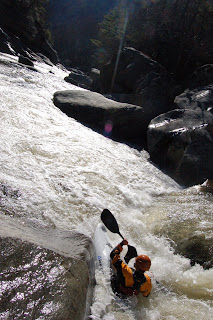


Once off the river the Linville paddler must hike a mile and a half long trail that climbs over a thousand feet up to the rim of the gorge. When you finally make it up to the car you arrive humbled. As if the beauty of The Linville Gorge alone were not enough, the experience of paddling there always reminds me of just how small I am in comparison to the forces of nature. In the summer of 2008 two paddlers Chris Gragtmans and Adam Herzog paddled The Linville Gorge 3 times in one day, a landmark accomplishment in anyone's eyes. The high water runs totalled up over 15 miles of whitewater and 7+ miles of hiking...talk about humbling.


What a way to finish off the 2008 paddling season! Many thanks to Will Stubblefield for taking these amazing photographs. Thanks also to everyone involved in getting Sundog up and running this year. The upcoming year already looks to be a busy one. I will spend the winter helping instruct EMT's in Watauga county, then I'll return to the Student Wilderness Medicine Conference for the second year, this time as a presenter. After that we'll be off to Colorado for swiftwater rescue training on Clear Creek. Who knows what else is in store. Here's to a happy and healthy new year, hope to see you down stream!